Home Annual Profections
Annual Profections
One year, one sign = the thread running through your next 12 months
Where profections come from
The word comes from the Latin “profectio”, departure or advancement: each year, the chart moves forward by one sign.
Profections have travelled through the centuries. Already fully formed in the founding texts of Hellenistic astrology, they find their finest witness in Vettius Valens and his Anthologies (c. 150-175 CE).
Brought back to light in the 1990s through translations of the ancient treatises, this age-old method offers today a tool of formidable clarity for following the thread of a life, year after year.
What is an annual profection?
Profections work like a personal weather forecast for the year. Each birthday opens a new twelve-month chapter, guided by a specific energy and a specific planet.
The method
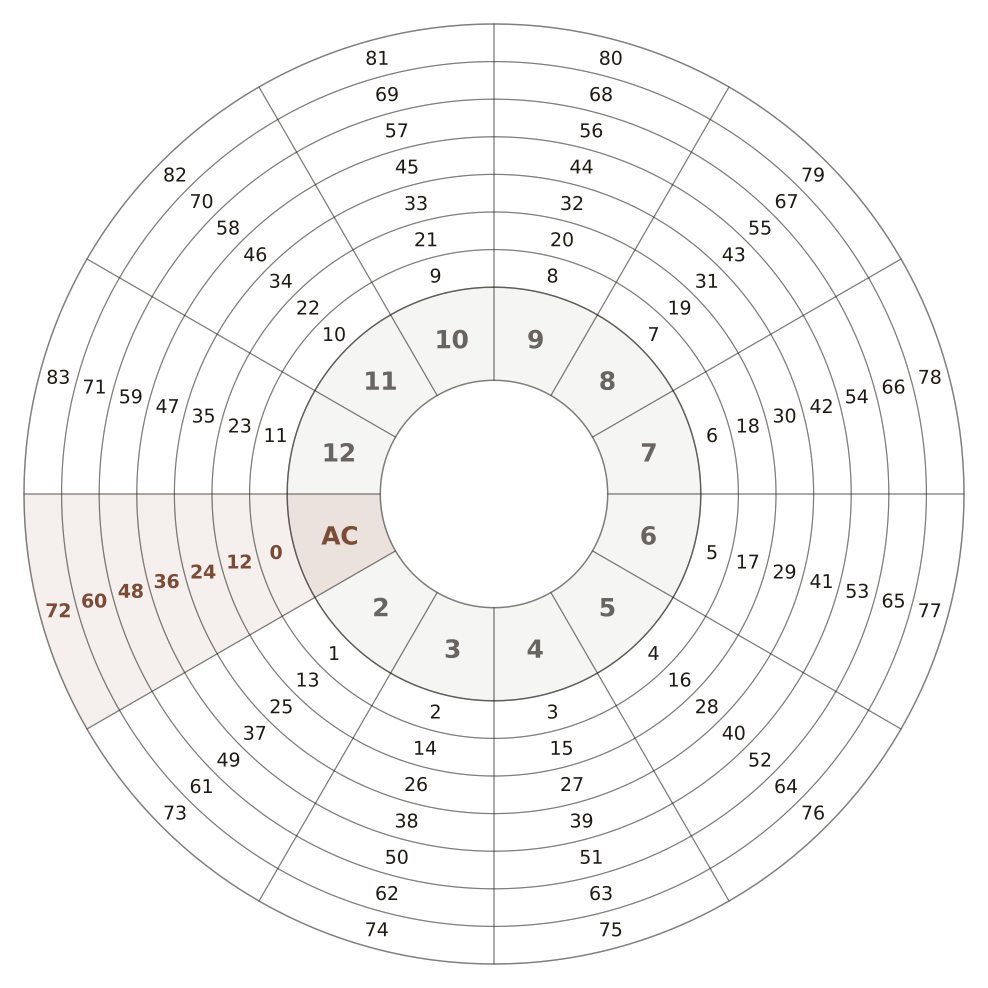
- The rhythm (one year = one sign) : At each birthday, the Ascendant moves forward one whole sign. To find it, first locate the age on the profection wheel: it shows which house is profected for the current year. This is the profected Ascendant. Cross-referencing with the natal chart (using whole sign houses), you then identify the sign occupying that house.
- The mood : It is the combination of the sign’s energy and the theme of the house being travelled through that defines the general climate of the twelve months ahead.
- What energies does the profected sign carry this year?
- What will the major themes be for the native?
- What is the trajectory and the focus of the year?
- The Lord of the Year : The planet ruling the activated sign becomes the main guide for the year. Its transits, its retrograde phases and its original position in the natal chart take on critical importance. It is also very useful to cross-reference with the Solar Return: where does the lord of the year sit in the Solar Return chart?
- Planets present : If natal planets occupy the profected house, they are also awakened and play a leading role during the year.
Profections in Lishu
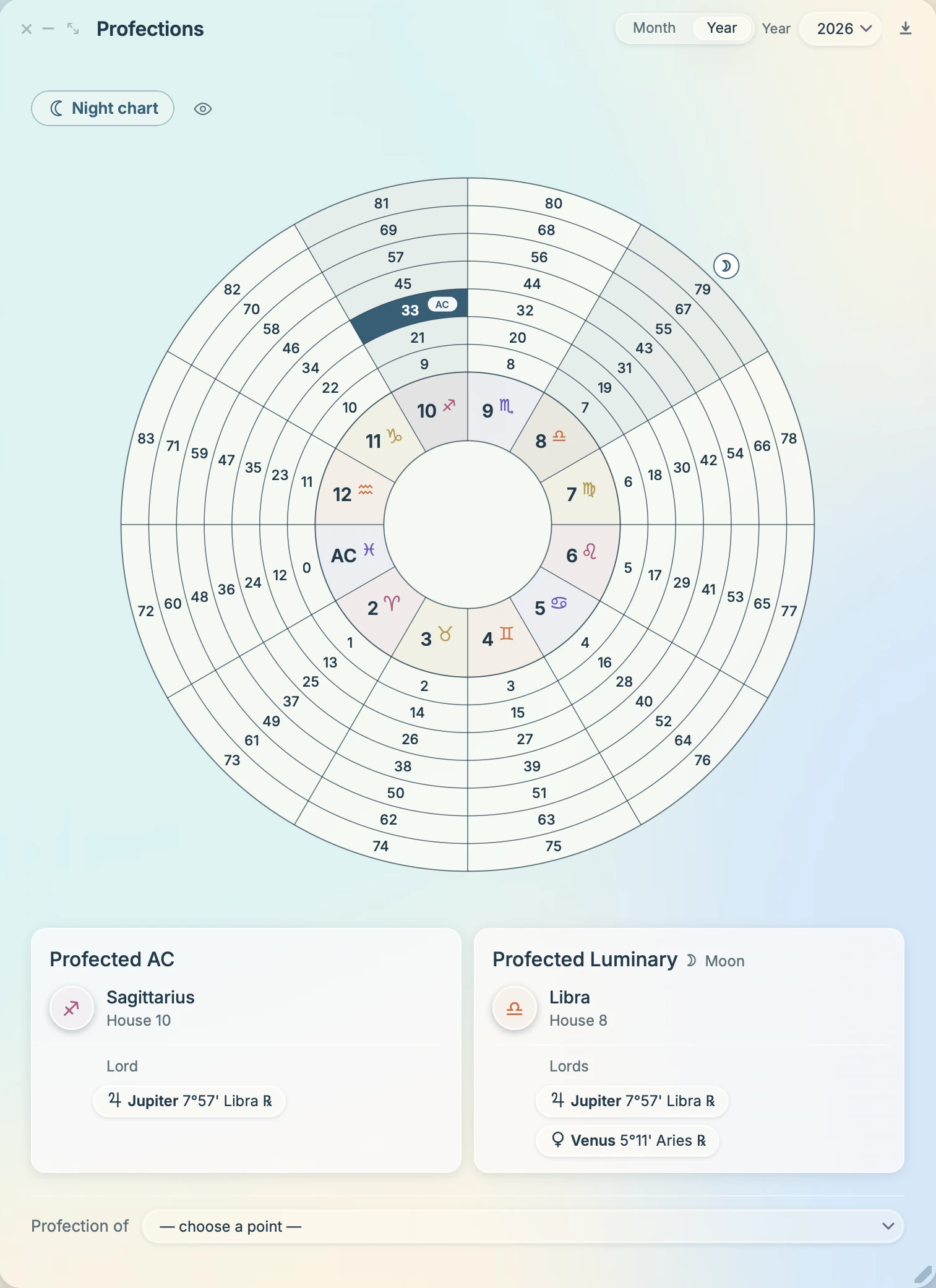
Calculate your profections automatically in Lishu, the professional online astrology software.
Load a profile and display the profection wheel: it sets itself on the chart’s Ascendant.
You read the profected Ascendant and the lord of the year, without calculating anything.
Lishu also profects the luminary according to the chart’s sect, and flags the planets present in the profected sign: they count in your analysis.
You can profect other points, as many as you wish, and read the year of your choice.
Monthly profections are calculated too.
Frequently asked questions
- Profection or Solar Return?
-
Both!
In astrology, it is always advisable to cross-reference at least two distinct techniques in order to obtain solid confirmation of the trends you are looking for.
Far from being at odds, these two tools are perfectly complementary.
Together, these two methods considerably lighten the work of analysing transits. They make it possible to isolate quickly the planets that genuinely affect the native, bringing to light the transits that really matter and the key moments of the year.
- Are only Ascendants profected?
-
Not at all!
While the Ascendant remains the preferred starting point, every element of a natal chart can be profected to enrich the analysis:
- The sect light : It is particularly recommended to profect the Sun for a day chart (born during the day) or the Moon for a night chart (born at night), in order to gain complementary reading keys on vitality and general orientation.
- The other elements of the chart : The luminaries, the house cusps, all the planets, the angles (such as the Midheaven) or the Arabic parts (such as the Lot of Fortune) can all be profected in order to target specific areas of life.
- Are there monthly profections?
-
Yes!
Profections do not stop at the scale of the year: monthly profections also exist. They bring a sub-tone and a finer light to the mood of each month.
Within this dynamic, the Lord of the Month takes on a leading role: its movements and the transits touching it become particularly significant for observing how the astrological climate evolves through the year.
Sources
- Ancient tradition, Manilius, Dorotheus of Sidon, Ptolemy, Vettius Valens, Firmicus Maternus, Paulus Alexandrinus, Hephaistio of Thebes
- Vettius Valens, Anthologies, Book IV c. 150-175 CE
- Dorotheus of Sidon, Carmen Astrologicum, Book IV 1st century
- Chris Brennan, Hellenistic Astrology: The Study of Fate and Fortune 2017
- Project Hindsight, translation of the Greek and Latin texts from 1993
- Chris Brennan, Annual Profections: A Timing Technique from Ancient Astrology The Astrology Podcast, video
- Annabelle Lhem, L’Architecture du Temps : Maîtriser les Profections et la Révolution Solaire video