Home Dominant planets
Dominant planets
How do you calculate your dominant planet in astrology? Discover the Berthon and Lilly methods and the Almuten Figuris.
Where dominant planets come from
Measuring a planet's strength is a centuries-old practice. Traditional astrologers used dignity tables to assess the power of a planet according to its sign and exact degree.
Over the centuries, several great schools of calculation emerged. Here is a selection of three of them:
- The point-scoring system (William Lilly, 1647)
- The Almuten Figuris (Ibn Ezra)
- The modern weighted calculation (Jacques Berthon)
What is a dominant planet?
The dominant is the planet that exerts the strongest influence over a natal chart: it sets its background colour and its driving dynamic.
However, the notion of “power” varies with the lens you use: a planet can stand out because it touches an angle, because it is particularly strong in its sign, or because it rules the key points of the chart.
Because these three approaches follow different logics, they do not always point to the same candidate. A dominant is therefore not a fixed point engraved in the chart, but the result of a calculation whose outcome depends entirely on the scoring system you choose.
The methods
Lilly (the traditional approach)
In his treatise Christian Astrology, Lilly awards points for every dignity and removes some for every weakness, producing a total score for each planet.
It measures the planet's actual strength where it stands. His system evaluates five essential dignities (from domicile to face) as well as accidental dignities. The latter take into account the house, motion, speed, the relationship to the Sun, exact aspects to benefics and malefics, the phase of the Moon and three fixed stars. The calculation relies on the seven traditional planets.
The Almuten Figuris (pure rulership)
This ancient method does not dwell on the planet's position, but on its rulership.
The analysis examines five fundamental places: the Sun, the Moon, the Ascendant, the Part of Fortune and the syzygy preceding birth. For each of these points, it identifies which planet rules the degree in question, then adds up the scores. The planet with the highest total is named the Almuten Figuris, the true lord of the chart.
Berthon (the weighted approach)
More recent, this approach places angularity at the centre of everything and gives priority to planets sitting on the chart's major axes.
A planet conjunct the Ascendant earns up to 60 points, 55 at the Midheaven, 50 at the Imum Coeli and 45 at the Descendant. The calculation then adds rulerships, stelliums, aspects to the luminaries and dignities. This method works with ten planets and takes modern rulerships into account.
Dominant planets in Lishu
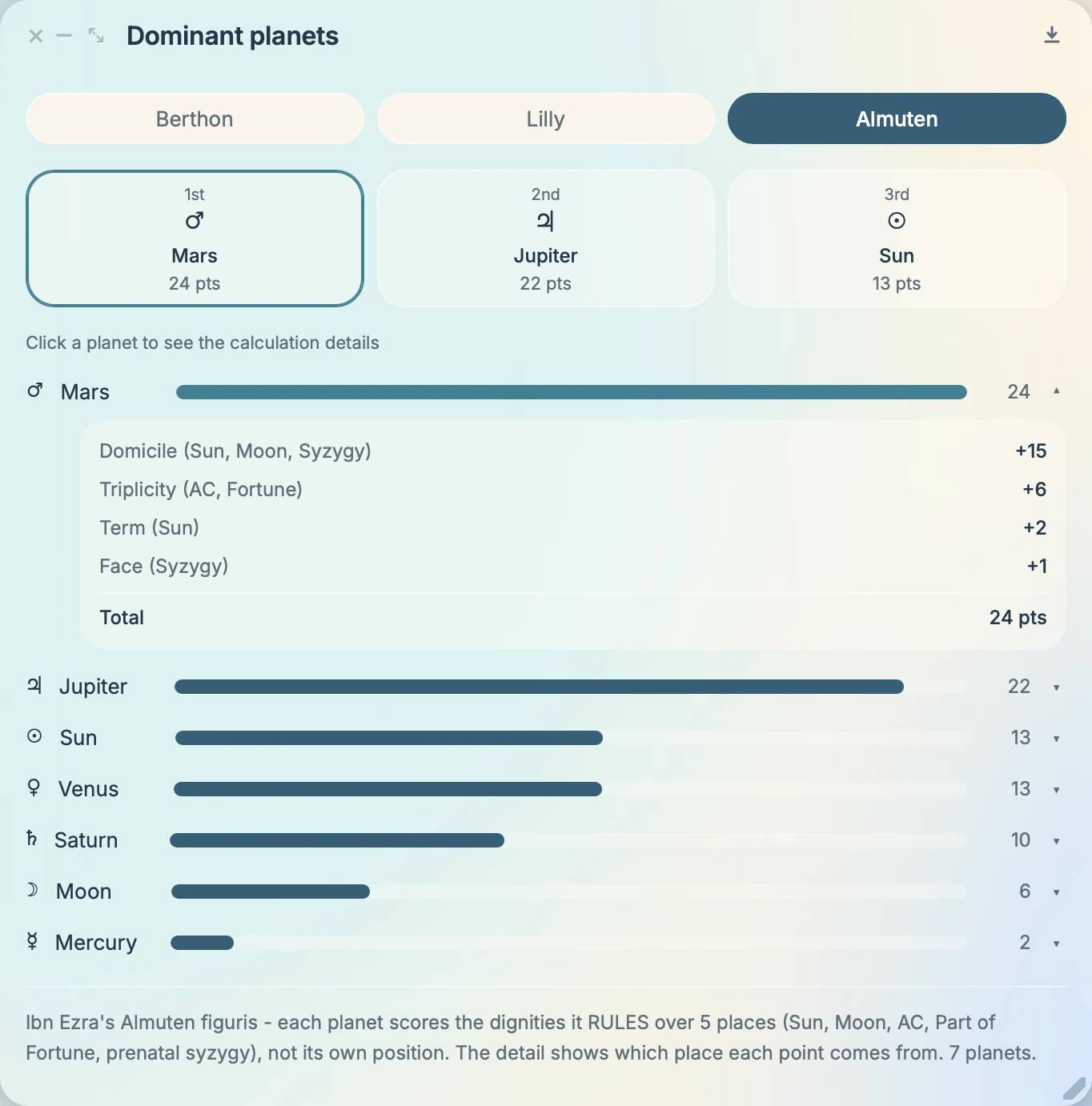
Lishu instantly calculates the dominant planets of any chart with a precision calculation engine.
- A fluid toggle : As soon as a profile is loaded, the three methods (Lilly, Almuten Figuris and Berthon) are generated in parallel. One click switches from one to another to compare the results.
- A clear view of the ranking : A podium highlights the leading trio, followed by the full ranking with the total score obtained by each planet.
- Full transparency : Unfold a planet and the calculation appears line by line, showing exactly where every point comes from. For the Almuten Figuris, the system even states the precise origin of each attribution.
- Documentary rigour : Each method comes with an explanatory note detailing its historical source, its scoring system, and the technical choices made where the traditional texts remained silent.
Frequently asked questions
- Why do the three methods give different results?
-
Because they do not ask the same question. Three different podiums are not an inconsistency: they are the sign that each method is doing its job.
The Berthon method asks: who takes centre stage? It is a measure of presence, where angularity comes first and stelliums count. All ten planets compete, the modern ones included.
The Lilly method asks: who is in the best shape? It is a score of condition, based on dignities, speed, the relationship to the Sun and exact aspects. A planet can sit enthroned on the Ascendant while being weak in state, brilliant in position but destitute of dignities. Only the seven traditional planets are assessed.
The almuten figuris asks: who holds the keys? This method does not look at where the planets are, but at who rules the five vital places of the chart (the Sun, the Moon, the Ascendant, the Part of Fortune and the prenatal syzygy). A planet can rule everything from a quiet corner of the chart, a lord without being a star.
In plain words: the star, the athlete, the owner. Nothing forces the three to be the same planet, and for most people they are not. That is precisely the value of the comparison: a planet that shows up on two podiums deserves your attention, and a planet that wins everywhere is an undisputed dominant.
Two details to keep in mind when comparing: Uranus, Neptune and Pluto can only appear with Berthon, as the other two methods stick to the seven traditional planets; and a gap between the podiums often says more than a victory, a planet very strong with Lilly but absent with Berthon acts powerfully but discreetly.
- What is the almuten figuris?
-
Almuten means the strongest.
Every degree of the zodiac has its almuten, the planet that rules it best through its dignities. One can therefore calculate one for any topic of a chart, marriage, children, health, career, by examining the points that govern that topic.
The almuten figuris is the almuten of the whole figure, that is, of the chart itself. Five places are examined together and the scores add up. The planet with the highest total is the lord of the chart.
These five places come from Ibn Ezra: the Sun, the Moon, the Ascendant, the Part of Fortune and the prenatal syzygy, that is, the last New Moon or Full Moon before birth.
This method therefore never looks at a planet's position, only at what it rules.
- Can you have several dominant planets?
-
Yes, and it is even the most frequent case.
The ranking matters as much as first place: two planets very close in points share the colour of the chart, whereas a clear gap designates an outright dominant.
The three methods cross-check each other usefully. A planet that tops all three is a solid dominant. A planet that only stands out in one tells you something subtler.
Sources
- William Lilly, Christian Astrology 1647
- Deborah Houlding, Understanding Planetary Dignity and Debility, Skyscript dignity points table
- Ibn Ezra, the five places of the almuten figuris
- Dorotheus of Sidon, triplicity rulers 1st century
- Jacques Berthon, weighted method scoring